

Interstate licensure compacts have transformed how healthcare professionals practice across state lines, streamlining licensing and expanding access to care. The Occupational Therapy Licensure Compact (or OT Compact, for short) is the version designed specifically for occupational therapy practitioners. Although it has been in development for several years, 2026 marks a major turning point as the first states begin issuing compact privileges to practice.
In this blog post you’ll find:
- What the Occupational Therapy Licensure Compact is
- Where the compact stands today (including an OT Compact map update)
- How it benefits occupational therapists and licensed assistants
- Which factors are influencing state adoption of the OT Compact
What Is the Occupational Therapy Licensure Compact?
The OT Compact is an interstate licensing agreement that allows occupational therapists and occupational therapy assistants who are licensed and reside in a participating member state to practice in other member states via a compact privilege, which functions much like a multistate license.
Unlike a traditional OT license that is valid only in the issuing state, a compact privilege lets practitioners work remotely, in person, or via telehealth across member states without securing separate licenses in each of those states.
The OT Compact preserves state licensure authority but enhances portability, continuity of care, and workforce mobility. Each state’s legislature must pass the compact into law before practitioners in that state can participate.
2026 Update: OT Compact Is Becoming Operational
While many states have enacted the compact language into law, the OT Compact is now beginning to issue compact privileges in certain states. The first three OT Compact states that have completed the technical and administrative steps needed to actually grant privileges are:
- Ohio
- Minnesota
- West Virginia
These states are actively issuing compact privileges to eligible practitioners, meaning occupational therapy clinicians whose home state license and residence are in one of these states can apply to practice in other member states without securing individual licenses.
OT Compact Map of Member States
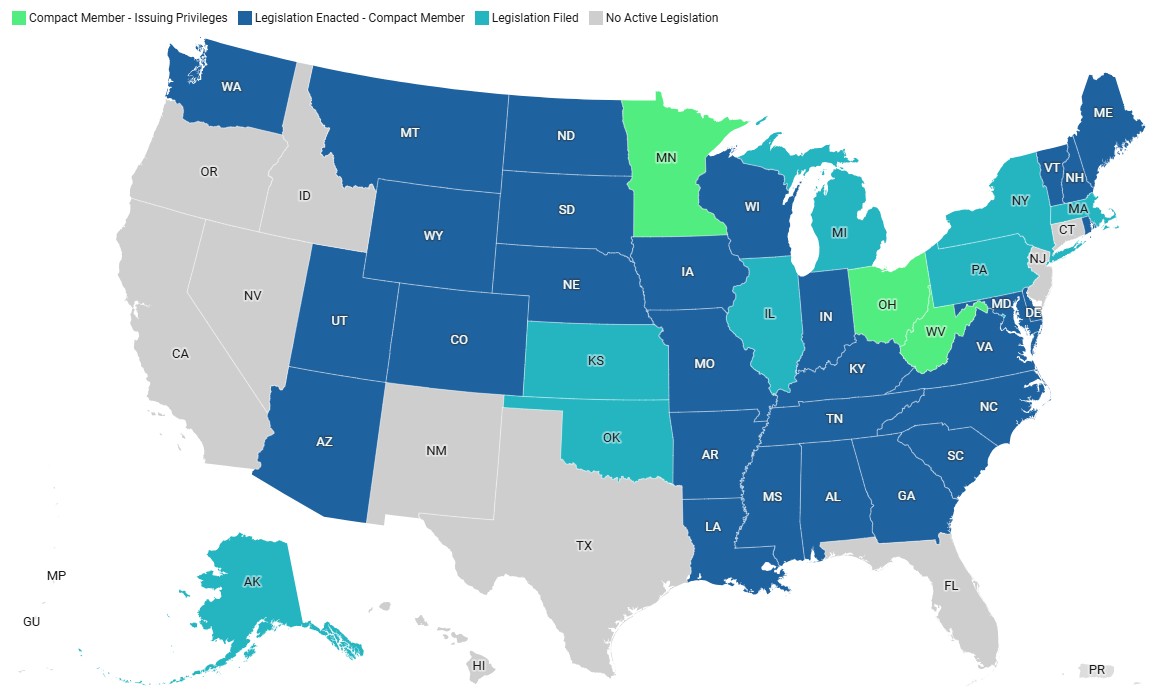
As of early 2026, 30+ states have enacted the Occupational Therapy Licensure Compact into law, including:
Alabama, Arizona, Arkansas, Colorado, Delaware, Georgia, Indiana, Iowa, Kentucky, Maine, Maryland, Minnesota, Mississippi, Missouri, Montana, Nebraska, New Hampshire, North Carolina, North Dakota, Ohio, South Carolina, South Dakota, Tennessee, Utah, Vermont, Virginia, Washington, West Virginia, Wisconsin, and Wyoming.
OT Compact states with pending legislation to join include Massachusetts, Michigan, New York, Oregon, and Pennsylvania.
Benefits of the Compact for OTs and COTAs
The Occupational Therapy Licensure Compact is designed to help both practitioners and patients. Key benefits include:
1. Easier mobility for licensed OT practitioners
OT and COTA clinicians in member states can work in other compact states without applying for individual licenses in each one once they’ve obtained OT Compact privileges.
2. Better access to care for occupational therapy patients
By reducing licensure barriers, the OT Compact helps fill gaps in services, especially in rural and underserved regions.
3. Expanded occupational therapy telehealth opportunities
Telehealth across state lines becomes simpler, offering more flexibility for OT providers and more options for clients.
4. Workforce flexibility
Military spouses, travel rehab therapists, and those relocating can more easily continue their OT careers in new states.
5. Streamlined communication between OT Compact states
A shared database allows for instant verification of OT licenses and disciplinary history, enhancing public protection.
Factors Influencing State Adoption of the OT Compact
Despite broad support, a handful of states have not yet enacted OT Compact legislation. Reasons include:
Legislative priorities and timing
State legislatures have limited sessions and competing priorities, which can delay compact bills.
Administrative and technical readiness
States must integrate their licensure systems with the CompactConnect database and complete internal rulemaking before privileges can be issued, which takes time and resources.
Cost and perceived value
Some policymakers are reluctant because of startup costs or uncertainty about the long-term value compared to current practices.
OT licensing revenue concerns
Licensing fees are a source of state revenue, and some boards worry about changes to fee structures or potential loss of income if occupational therapy practitioners use compact privileges instead of traditional licenses.
Where the OT Compact Goes Next
The momentum around the Occupational Therapy Licensure Compact is strong. Now that OT Compact privileges have begun to be issued in certain states, other member states are expected to complete their integrations and open applications soon. OT practitioners in nearly every participating state should keep abreast of updates for details on how and when compact privileges will become available.